Case Study / Experiment 01 / Day 1
We exported ChatGPT's citation list for "best AEO tools." There is no gatekeeper.
We paid for Airefs, pointed it at this website, and set it running for 90 days. This is the day-one baseline: what we tracked, what the tool showed us, and what we found when we exported the raw data instead of reading the dashboard's summary.
We expected a boring first entry. Our site was one day old. Of course it would be invisible. The interesting part was supposed to arrive in month two.
Then we exported the citation list and found something that reframes what a small business should even be trying to do.
The Short Version
Across ten purchase-intent prompts, ChatGPT produced 146 citations drawn from 96 different domains. The most-cited site accounted for 7 percent of them. Seventy-five of the 96 domains were cited exactly once. The citation graph for this category is flat and fragmented, not concentrated. There is no small set of authority sites you have to beat. That is a fundamentally different game from Google search, and almost nobody selling AEO tools describes it accurately.
What we set up
Test site: visibilitybench.com, this site. We are using ourselves as the first subject rather than a client, because a brand new domain gives a true zero baseline, which no existing case study we could find has ever published. A second experiment on an established small business site will run in parallel later.
Tool: Airefs. We chose it because it is the cheapest published entry point in the category and because it focuses on ChatGPT and Google AI Overviews, which is where small business customers actually are. We are also an applicant to their affiliate program, which is a conflict of interest and is why this test exists rather than a recommendation.
The tool auto-generated ten prompts for us. All ten were category-discovery questions of the "best tools for X" variety. We deleted five and replaced them with a mix, so the final set tests three different things: whether we surface for category questions, for how-to questions, and for tool-comparison questions. That distinction matters, because they behave very differently.
The baseline: zero, and so is everyone else
Our visibility across all ten prompts: 0 percent mentioned, 0 percent cited. Expected, for a site that had existed for about nine hours.
The part we did not expect: all three of our chosen competitors also scored zero. These are established sites that publish AEO comparison content and rank well enough in Google that we found them while researching this category. Across ten highly relevant purchase-intent prompts, ChatGPT named none of them.
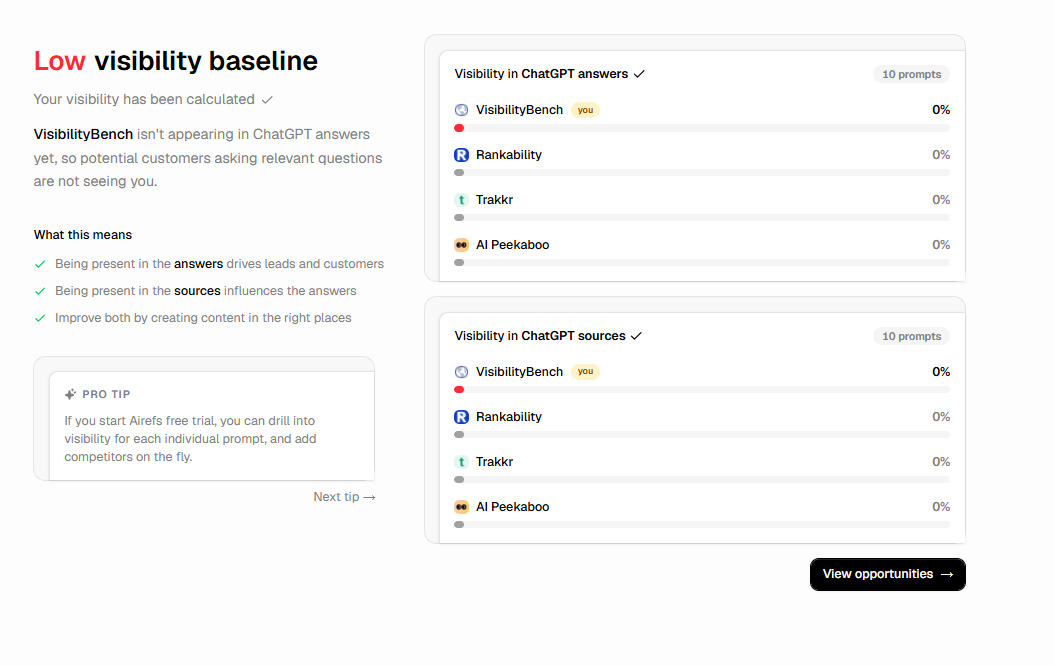
So the obvious question became the interesting one. If not them, then who?
What ChatGPT actually recommends
For the prompt "Best AEO tools for local businesses," ChatGPT produced a structured answer with a comparison table, a shortlist broken out by business type, and a budget-tiered recommendation. The tools it named: Otterly.AI, Semrush's AI visibility features, Ahrefs' AI visibility features, HubSpot's AEO tools, Surfer SEO, and Profound.
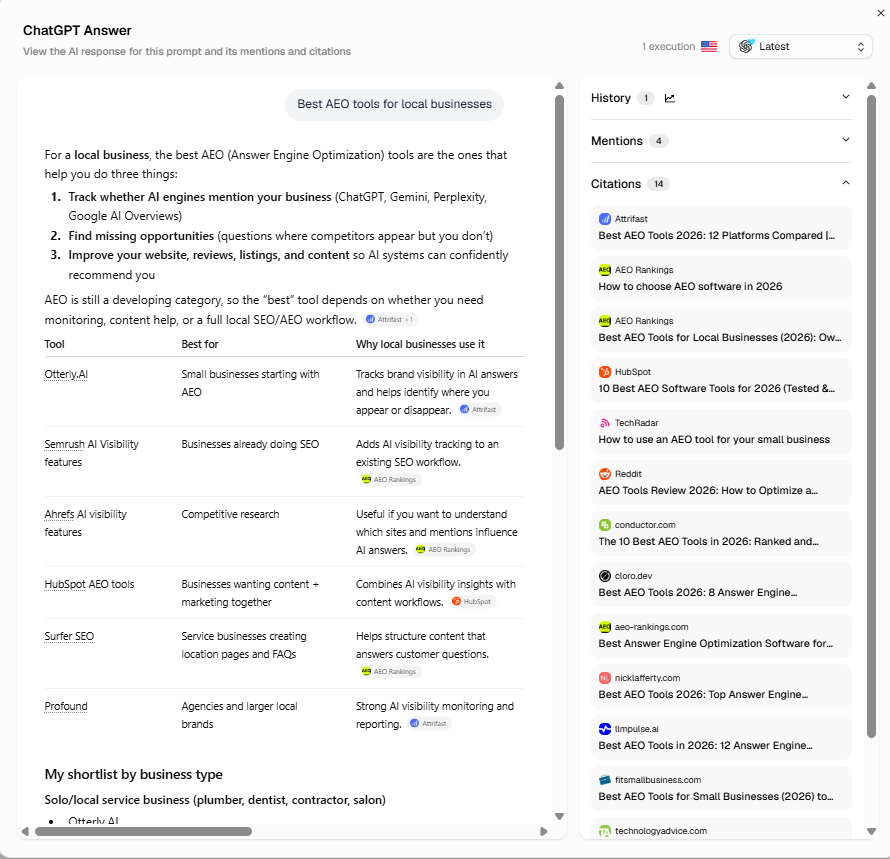
Note what that list is. One dedicated AEO startup, and then the incumbent SEO platforms. Semrush, Ahrefs, HubSpot, and Surfer are not AEO companies. They are established tools that added AI visibility features and already had the brand authority to be recommended. The established players are absorbing this category from above, and the dashboards do not tell you that.
The export, which is where the real finding was
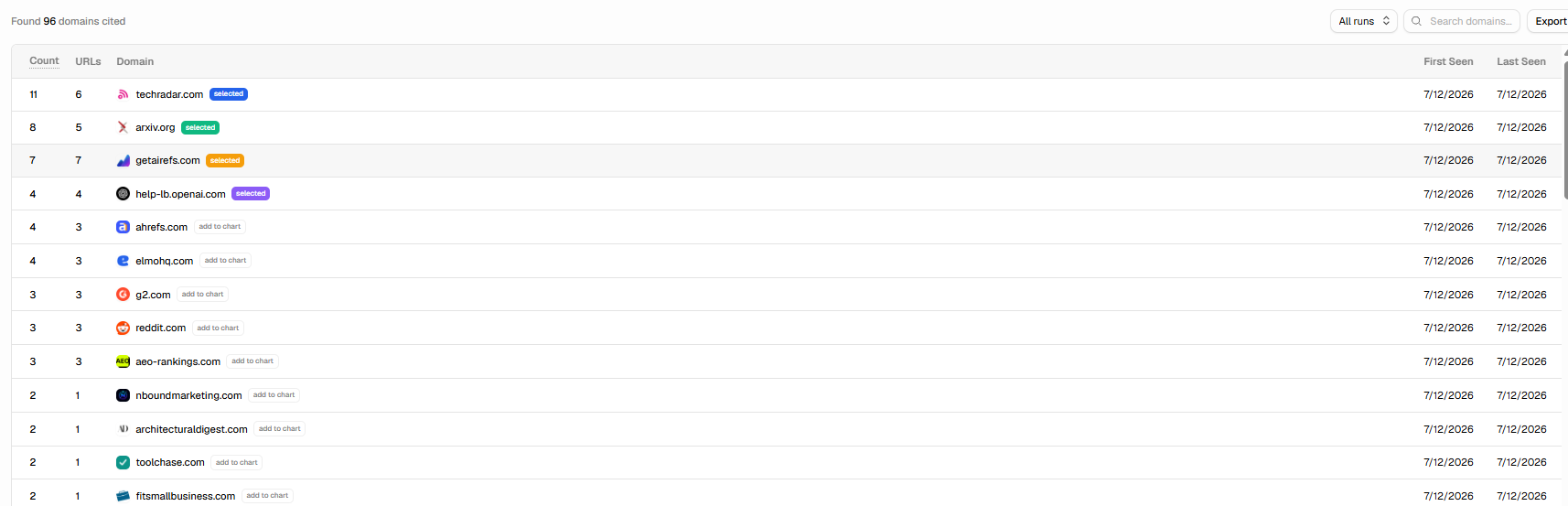
The dashboard shows you a number. The export shows you the machinery. We pulled every source ChatGPT used across all ten prompts.
| Metric | Value |
|---|---|
| Total citations | 146 |
| Distinct domains cited | 96 |
| Distinct URLs cited | 127 |
| Most-cited domain | techradar.com, 11 citations (7.5 percent) |
| Top 5 domains combined | 34 of 146 citations (23 percent) |
| Domains cited exactly once | 75 of 96 (78 percent) |
Sit with that last row. Three quarters of the sources ChatGPT relied on to answer these questions were used a single time.
Why that number matters more than your visibility score
Everyone shopping for an AEO tool is carrying a mental model borrowed from Google, where the top few results take most of the traffic and a handful of authority domains gatekeep every competitive category. Under that model, a small business looks at AI search and reasonably concludes it has no chance. You cannot outrank TechRadar.
But you do not have to. TechRadar accounted for 11 of 146 citations. The top five domains together accounted for less than a quarter. The rest of the answer was assembled from a long, flat tail of small sites, each contributing once.
The bar for entering that tail is a single citation. That is not a moat. That is a door.
What the long tail is actually made of
We looked at the 75 single-citation domains expecting a mix of trade press, blogs, and directories. That is not what we found.
Names from the list: ospea.io, lightsite.ai, rankcite.com, citovo.com, llmpulse.ai, getvaeo.com, localfox.ai, geobuddy.co, geo-tool.com, geogryphon.com, scanmygeo.com, answermonk.ai, attrifast.com, cloro.dev.
Those are not publications. They are AEO tool vendors. The long tail of sources ChatGPT uses to decide which AEO tools to recommend is, to a substantial degree, the marketing websites of AEO tools.
The category is citing itself into existence.
This is the thing we built this site to look for, and we found it on day one, in the export of a tool we are paying for. The third most-cited domain across all ten prompts was getairefs.com, the vendor whose product we are testing, with 7 citations across 7 separate URLs. More than Ahrefs. More than G2. More than Reddit.
The uncomfortable conclusion, stated plainly
We started this project expecting to find that vendor-written comparison content was polluting the category. We did find that. But the honest reading of our own data is more awkward than the story we expected to tell.
It works. Airefs publishes competitor comparisons that rank Airefs first. That content is now one of the most-cited sources in the category. Their strategy is not a con. It is a functioning strategy, demonstrably, in a dataset we pulled ourselves. Any honest review has to say so.
What we take from that is not that the practice is fine, and not that it is a scandal. It is that the citation graph rewards whoever shows up. It rewarded the vendors because the vendors were the only ones writing. Almost nobody independent is in that list of 96 domains, because almost nobody independent is doing this work.
Which is the entire reason this site exists, and now we have the data to say so instead of just asserting it.
One more thing worth flagging
Two of the 146 citations came from architecturaldigest.com. Architectural Digest, the interior design magazine, cited in an answer about AI visibility software for small businesses.
We do not know why. It might be a syndicated tech piece. It might be noise. But it is a useful reminder that the citation graph is not a pure meritocracy, and that any tool selling you a visibility score is scoring a system with unexplained behavior in it. Anyone who tells you AEO is a solved, mechanical discipline is selling something.
What we are doing over the next 90 days
The strategy follows from the data. We are not trying to beat TechRadar. We are trying to become one of the 96.
- Publish original data, not opinions. This article is the first test of that. Citation-graph analysis is something we can produce and a vendor blog will not, because it does not flatter anyone.
- Target the how-to prompts first. Category prompts are dominated by incumbents with brand authority we do not have. How-to questions are winnable with a genuinely better answer. We have one published.
- Get into the source list, not the rankings. Being cited once is the achievable goal. Being recommended is the downstream effect.
- Log every change. Every edit to this site gets recorded here so results can be traced to actions rather than guessed at.
We will publish the numbers monthly, whether they move or not. If 90 days of work produces nothing, that will be the headline, and it will be worth more to you than another case study where the number conveniently went up.
Disclosure
We paid for Airefs with our own money. No vendor gave us free access, a discount, or advance sight of this article. We have applied to the Airefs affiliate program and have not been approved at the time of writing. There are no affiliate links on this page. Our full policy is on the disclosure page.
If you want to check your own AI visibility before spending anything, our free ten-minute method costs nothing and will tell you whether you have a problem worth paying to solve.
Update Log
- July 13, 2026 / Day 1
- Baseline captured. Visibility 0 percent across 10 prompts, as expected for a one-day-old domain. All three competitors also at 0 percent. Citation export analyzed: 146 citations, 96 domains, 78 percent cited exactly once. Trial started on the Pro plan, which is the only tier offering a free trial.